What the AI Product Shake-Up Means for Users in 2026 as Grok Bot, ChatGPT and Claude Redraw Their Boundaries
Need articles like this for your video? They help promote it on YouTube and Google — order them in the Telegram bot @sat_sit_bot. It writes articles around your video, embeds the video and publishes them on popular niche websites (no ads). Try it free: 50 articles on us.
· based on the channel Paul J Lipsky
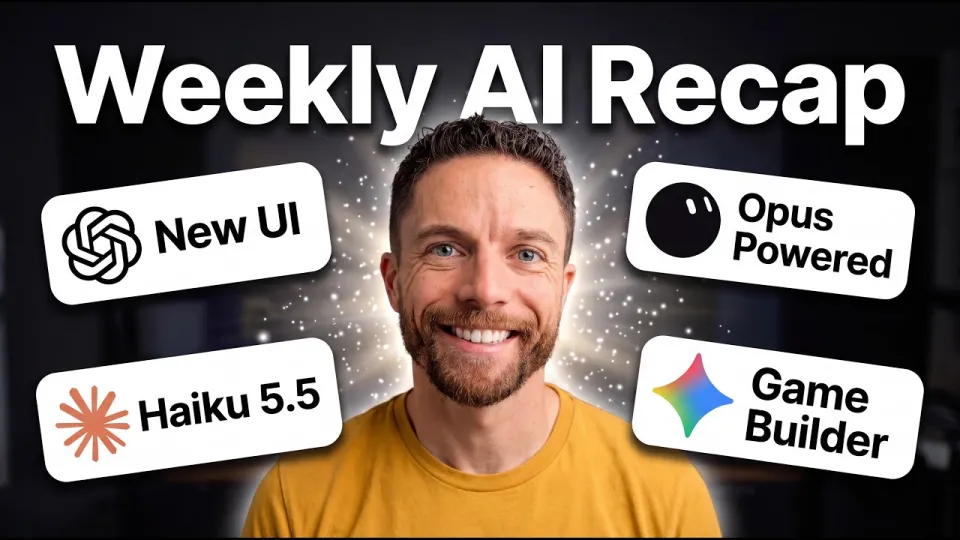
AI in 2026 is less about one model winning and more about who gets to route your request. The week's biggest signal is Grok Bot's plan to call on Claude, Midjourney and Suno alongside its own tools, while ChatGPT gets a reworked Intelligent UI and Claude Cowork moves into the cloud. The full walkthrough is in Paul J Lipsky's weekly recap, and the sponsor slot points to Okou's site for the launch offer and a free trial of its agent platform.
Why Grok Bot reaching for Claude, Midjourney and Suno matters
Grok Bot is being repositioned from a chatbot with a personality into an orchestrator that outsources work to other companies' models. That is the unthinkable part of the headline: a product built by one AI lab planning to route tasks to a competitor's language model, a rival image generator and a separate music service.
Read the strategy in three layers:
- Routing over ownership. Instead of training a single model to be best at chat, images and audio, the bot decides which engine fits the request and hands it off.
- Agent behaviour. The bot is described as taking a task end to end — gathering inputs, producing a script or asset, then returning a finished result rather than a draft.
- Vendor mixing. Claude covers long-form reasoning and writing, Midjourney covers visuals, Suno covers audio. Each is a specialist the bot does not have to build.
One viewer described handing a bot a shared folder of business videos, asking for a social cut, receiving a voice script, recording it and getting back a result better than a paid contractor's. That is the practical promise of orchestration: the value sits in the workflow, not the model card. It also raises the obvious questions — who pays for the third-party calls, how permissions work when an agent reads your photo library, and what happens when a routed request fails mid-task.
ChatGPT's Intelligent UI changes the surface, not just the skin
ChatGPT's new Intelligent UI is a redesign of how the product decides what you are trying to do. Rather than a single blank prompt box, the interface surfaces tools, model choices and follow-up actions based on context.
What to expect in practice:
- Fewer manual model switches. The system picks reasoning depth or a tool instead of making you choose from a dropdown.
- Task-shaped entry points. Writing, analysis, image work and research get distinct starting paths.
- More visible state. Long-running jobs show progress instead of a spinner, which matters as agents take on multi-step work.
A redesign like this is usually more consequential than a model bump. Most users never change default settings, so whatever the interface puts in front of them becomes the product. If the new UI nudges people toward agentic, multi-step tasks, usage patterns shift with it.
Anthropic pushes Claude Cowork into the cloud
Claude Cowork moving to the cloud turns a local, desktop-bound collaboration setup into a hosted one. The pitch is that a team can share a working session around Claude without every participant running the same local environment.
Three consequences follow:
- Access gets easier. Onboarding no longer depends on installing and configuring a local client.
- Shared context becomes possible. Cloud sessions can hold project files and history that several people reach.
- Data governance moves to the vendor. Hosted collaboration means retention, permissions and admin controls become part of the subscription conversation.
The move fits a broader pattern: Anthropic has been steadily pushing Claude from a chat window toward a work surface where documents, code and agents live side by side. Cloud hosting is the plumbing that makes team-level use realistic.
Google's Gemini plan reshuffle and the Playground test
Google spent the week adjusting how Gemini is packaged and tested. Plan changes matter because Gemini's tiers decide which model, context length and storage bundle a user actually gets — one viewer pointed out that a higher AI plan bundles a Pro-tier model with a large storage allowance, a detail that rarely makes the headline.
On the product side, Playground is the experimental surface where Google lets users try model behaviour before it ships broadly. Nano Banana 2.1, the next iteration of Google's image model line, was named among the updates. The takeaway for users is unglamorous but useful: check which model your plan maps to before assuming a capability is available, because tier names and bundled models drift apart over time.
The questions users keep asking about AI agents
The most common concerns around this wave of updates are practical, not philosophical, and they cluster into recognisable patterns.
- "I deleted something I did not recognise." New agent entries appearing in a sidebar without warning cause exactly this. If a bot shows up unannounced, check documentation before removing it — reinstating a deleted agent profile is not always possible.
- "Can I do this without writing code?" Yes for orchestrated workflows, less so for custom automation. The recurring request for a Claude Code explainer aimed at non-technical users reflects a real gap between agent capability and onboarding material.
- "What does the subscription actually include?" Plan tiers bundle models, storage and limits in ways that are not obvious from the pricing page.
- "Is the output good enough to replace a freelancer?" For templated social content, users report it increasingly is; for anything requiring judgement or brand nuance, review still matters.
What to watch next in the AI stack
Three threads will determine whether this week looks like a turning point or a footnote.
First, interoperability. If a bot can genuinely call Claude, Midjourney and Suno reliably, the competitive unit becomes the router rather than the model. Second, interface control. ChatGPT's Intelligent UI and Google's Playground both bet that shaping the entry point beats adding benchmark points. Third, cloud-hosted collaboration. Claude Cowork in the cloud tests whether teams will trust a vendor with shared working state.
For individual users, the practical advice is boring and effective: audit which model your plan actually gives you, learn one orchestration workflow end to end, and keep an eye on permission prompts when an agent asks to read your files.
Final takeaway
The week's AI news points in one direction: products are becoming schedulers of other products. Grok Bot courting Claude, Midjourney and Suno, ChatGPT rebuilding its interface around intent, Claude Cowork moving to hosted sessions and Google reshuffling Gemini tiers all describe the same shift from model quality to workflow quality. Paul J Lipsky's weekly format is a useful way to track that shift because it groups the chaos by company rather than by hype cycle. If you want to test an orchestration layer yourself, start with the Okou launch page and its trial offer before committing to a paid plan.
Key takeaways
- Grok Bot is being positioned as a hub that can call on Claude, Midjourney and Suno instead of relying only on its own models.
- ChatGPT is rolling out a new Intelligent UI that changes how tasks, tools and models are surfaced to users.
- Claude Cowork is moving to the cloud, shifting Anthropic's agent-style collaboration from a local setup to hosted sessions.
- Google is adjusting Gemini plan tiers and testing Playground, with Nano Banana 2.1 named among the image-model updates.
- A single AI subscription increasingly buys orchestration across several vendors rather than one model family.
Source: Weekly AI Recap: GrokBot Just Did the Unthinkable, ChatGPT Looks Completely Different & More! · Markdown version
Questions & answers
What is Grok Bot actually doing that is new?
Grok Bot is being positioned as an orchestrator that can route work to Claude, Midjourney and Suno instead of relying only on its own models. In practice that means a single request could produce text, images and audio through different vendors. The significance is strategic: the bot competes on workflow rather than on one model's benchmark score.
Is ChatGPT's Intelligent UI a new model or just a redesign?
It is a redesign of the interface layer that decides which tools, models and follow-up actions to surface. The underlying models may be unchanged, but because most users keep defaults, the interface effectively determines what the product feels like. Expect fewer manual model switches and more task-shaped entry points.
What changes for teams when Claude Cowork moves to the cloud?
Hosted sessions remove the need for everyone to run the same local setup, so onboarding gets simpler and shared project context becomes possible. The trade-off is that retention, permissions and admin controls now sit with Anthropic rather than on your machine. Teams should review data policies before moving sensitive work into shared cloud sessions.
Why do Gemini plan changes matter to ordinary users?
Plan tiers determine which model, context length and storage bundle you actually receive, and those mappings shift over time. A higher tier can bundle a Pro-level model with a large storage allowance, which is easy to miss on a pricing page. Check the current mapping before assuming a capability is included.